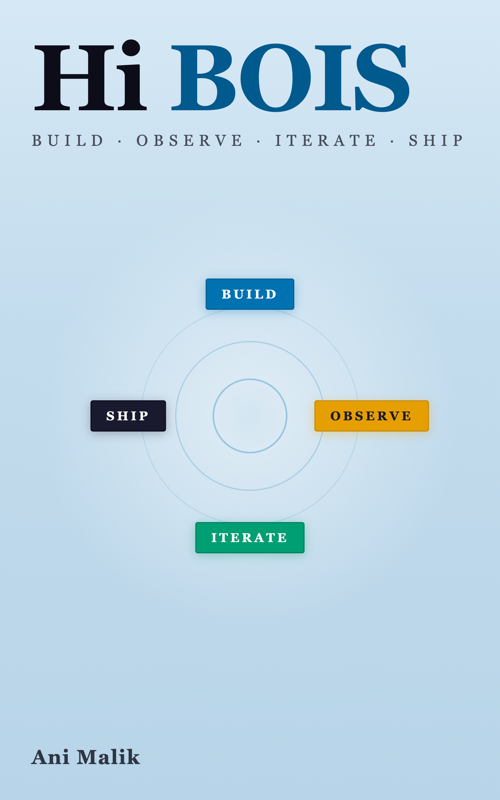
Hi BOIS
Build. Observe. Iterate. Ship.
The SDLC shaped software for decades. AI agents didn't make it faster. They collapsed it entirely. This book maps what comes next.
ISBN: 978-82-494-3361-1 · First Edition · February 2026
The Argument
The road isn't getting faster.
The road is disappearing.
Requirements, design, implementation, testing, review, deployment, monitoring. Seven stages that defined how software gets built for decades. AI agents didn't speed them up. They collapsed them into a single loop.
Build with the agent. Observe what happens in production. Iterate based on what you learn. Ship continuously.
Four words that replace seven stages, weeks of handoffs, and a billion-dollar ecosystem of tools built on the assumption that the stages remain separate.
The Framework
The BOIS Loop
Not a process. Not a methodology. A continuous loop where intent becomes working software in minutes, not weeks.
Build
Describe your intent. The agent produces code, tests, and deployment config in one pass. No tickets. No estimates. No handoffs.
Observe
Observability is the new safety net. When every checkpoint has been compressed, monitoring catches what everything else missed.
Iterate
When you can try three approaches in the time it used to take to debate which one, you stop arguing and start experimenting.
Ship
Deploy behind a feature flag. Roll out to 10%, then 50%, then 100%. In minutes (or hours), the fix is live for every user. That's the loop. The new rhythm of software.
Before & After
The Compression
The stages haven't disappeared. They've compressed from a weeks-long sequential process into a minutes-long iterative loop.
"Every era of software engineering has been defined by what was scarce. In the era we're entering, the scarce resource is judgment."
- Chapter 17: Epilogue
Inside the Book
What You'll Read
16 chapters across four parts. An argument, not a survey. From the world we built to what replaces it.
The World We Built
The Lifecycle
Where the SDLC came from, why it existed, and why it was a rational response to the constraints of its time.
The Tooling Industrial Complex
The billion-dollar ecosystem of tools built on the assumption that the stages remain separate.
The Collapse
The Merge
How the seven stages are collapsing into a single loop.
From Requirements to Intent
Specifications became intent. Context replaced contracts.
Architecture Through Conversation
Design emerges from conversation with the agent, not weeks of whiteboarding.
Implementation and Testing
Code and tests generated in the same breath. No handoffs.
The Death of the Pull Request
Human review shifts from line-by-line diffs to output validation.
Continuous Everything
Deployment becomes a non-event. Shipping is breathing.
Observability as Foundation
When every checkpoint has been compressed, monitoring is the last safety net.
The Hard Questions
Who Verifies the Verifier?
Verification trust chains in an automated world.
The Black Box Objection
When you can't explain how the code works because you didn't write it.
When the Agent Is Wrong
Confident wrongness and how to build systems that catch it.
Safety and Responsibility
Safety-critical systems, compliance, and the costs the industry doesn't want to talk about.
What Remains
Context Engineering
The replacement for the SDLC isn't a process. It's a skill.
The New Engineer
Judgment over typing. Taste over velocity. What the role becomes.
Organizations After Process
How teams, roles, and organizations restructure around the collapsed lifecycle.
Core Ideas
Three Things This Book Is Certain About
The Old Model Is Breaking
The seven-stage linear SDLC, with its handoffs and ceremonies, is increasingly disconnected from how software actually gets built. Teams that cling to it will move slower than teams that adapt.
Context Engineering Is the New Core Skill
The quality of what you build with agents is directly proportional to the quality of context you give them. Not the process. Not the ceremony. The context.
Observability Is the New Safety Net
When every other checkpoint has been compressed or automated, monitoring catches the failures that everything else missed. Teams that underinvest are building without a net.
From the Book
In the Author's Words
"This book is not a balanced survey of opinions. It is an argument. The argument is that the SDLC as we know it is finished, and that the teams who recognize this first will build things that the teams still running sprint ceremonies cannot."
Preface"It doesn't feel fast. It feels normal. It feels like the obvious way to build software. The speed isn't exhilarating because there's no contrast. It's just the rhythm. Intent, output, evaluation, refinement."
Chapter 3: The Merge"Telling an agent 'write clean code' produces nothing useful. Telling it 'all functions must have type hints, no Any types, money values are integers in cents, never floats' produces code that is clean in the specific ways that matter."
Chapter 14: Context Engineering"The SDLC didn't collapse because AI agents are magic. It collapsed because it was already fragile. The agents just applied the force."
Chapter 1: The LifecycleAudience
Who Should Read This
Software Engineers
Who want to understand what the role becomes when agents handle the typing.
Engineering Leaders
Who need to restructure teams and processes around the collapsed lifecycle.
CTOs & Decision Makers
Who make decisions about how software gets built and need the honest map.
Get in Touch
Contact the Author
Have a question, feedback, or just want to say hi? Send a message.
The old model is dead.
This is the map.
Build. Observe. Iterate. Ship. The new rhythm of software.
ISBN: 978-82-494-3361-1 · First Edition · February 2026